
As ‘Fire and Fury’ is published, Europe openly debates: ‘Is Trump still sane?’
“In many European capitals, the prevailing sentiment is helplessness and frustration that Trump won’t engage in a rational dialogue,” argued Stephan Bierling, a professor for transatlantic relations in Germany, who said that he had long admired the United States but that his beliefs were now “shaken to the core.”
“Once a relationship is in disorder there is no easy way back. Trump has succeeded at destroying Europeans’ trust in himself and the United States more broadly,” according to Bierling. The mental health concerns now raised in Wolff’s book and widely debated across Europe, he said, were exacerbating European politicians’ existing skepticism of Trump.
German Chancellor Merkel has mostly refrained from directly lashing out at Trump, but she said early last year that the United States was no longer a reliable partner. The White House, however, repeatedly disputed that transatlantic relations were in disarray. In May, then-White House press secretary Sean Spicer described Trump-Merkel relations as “fairly unbelievable” in a positive way. “They get along very well,” Spicer said.
Trump himself also praised French President Emmanuel Macron last September, saying that “(he's) respected by the French people, and I can tell you he is respected by the people of the United States.” At the time, Macron told reporters: “The strength that unites our relationship is that we say everything. That doesn’t mean we agree on everything, but we do agree on a lot of things.”
But in Germany, Trump’s unpredictable outbursts of anger have already played into the hands of those long demanding normalized relations with Russia, despite its annexation of Crimea and election meddling abroad. The chorus of voices demanding an end of sanctions against Russia are growing.
Moscow has had a strong lobby in Berlin for years and doubts over Trump’s reliability could now become one of their strongest arguments. Unsubstantiated claims alone would probably not force the German government to turn its back on the United States, but the allegations made in “Fire and Fury” appear to confirm what everyone has long suspected. Already a year ago, Sigmar Gabriel, Germany’s then-vice chancellor and now-foreign minister called Trump “a threat.” At the time, his remarks found little echo in the United States, even though they expressed a more widespread fear among European government representatives.
Macron, who has established a more extensive working relationship with Trump than the Germans were able to, also voiced an unusually stern warning this week, arguing that Trump’s policies could result in a war. Referring to Trump’s Iran approach, he said: “The official line pursued by the United States, Israel and Saudi Arabia, who are our allies in many ways, is almost one that would lead us to war.” His remarks came before excerpts from “Fire and Fury” emerged.
In Britain, a country that usually prides itself for having a special relationship with the United States, enthusiasm for that deep interlinking has weakened remarkably over the last year, as well. A scheduled Trump state visit to Britain was delayed and might never happen. And Prime Minister Theresa May publicly rebuked Trump after he retweeted videos shared by a far-right group in the country.
“This isn't a crisis Europeans will simply sit out,” said Bierling, the German transatlantic relations professor.
“Even once Trump is gone, the damage to the transatlantic alliance is almost irreversible now. There is no easy way back,” he said.
 French President Emmanuel Macron with President Trump in Paris on July 14. (Christophe Archambault/AFP/Getty Images)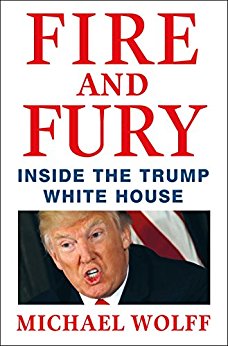
FIRE AND FURY
In this explosive book, Wolff provides a wealth of new details about the chaos in the Oval Office. Among the revelations:
— What President Trump’s staff really thinks of him
— What inspired Trump to claim he was wire-tapped by President Obama
— Why FBI director James Comey was really fired
— Why chief strategist Steve Bannon and Trump’s son-in-law Jared Kushner couldn’t be in the same room
— Who is really directing the Trump administration’s strategy in the wake of Bannon’s firing
— What the secret to communicating with Trump is
— What the Trump administration has in common with the movie The Producers
Never before has a presidency so divided the American people. Brilliantly reported and astoundingly fresh, Michael Wolff’s Fire and Fury shows us how and why Donald Trump has become the king of discord and disunion.
BERLIN — European commentary on President Trump is rarely flattering, but the cascading revelations alleged in Michael Wolff’s tell-all book “Fire and Fury,” drew an especially fierce response from a horrified continent this week.
“Is Trump still sane?” asked the Friday lead headline on the site of Germany’s most respected conservative paper, Frankfurter Allgemeine Zeitung. The piece was published under the topic “mental health.”
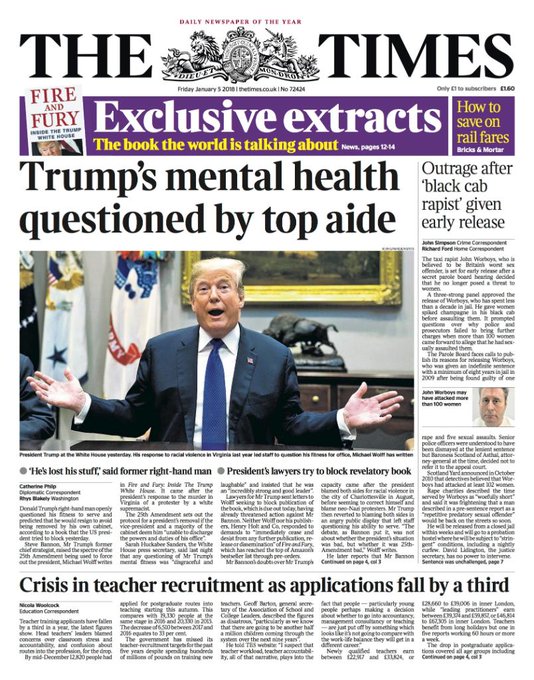
Meanwhile, British readers woke up to the Times of London's main front page headline that also wondered about the president’s stability: “Trump’s mental health questioned by top aide.”
“Donald Trump’s right-hand man openly questioned his fitness to serve and predicted that he would resign to avoid being removed by his own cabinet, according to a book that the US president tried to block yesterday,” wrote the Rupert Murdoch-controlled Times of London.
For its part, France’s paper of record, Le Monde, just described the book as “haunting.”
Trump has never been too popular in Western Europe, with approval ratings in many countries hovering in the single or lower double digits. But even though disagreement with Trump has almost become the norm here, some of Friday’s public responses to Wolff’s book still appeared unprecedented.
The Times of London and the Frankfurter Allgemeine Zeitung are some of Europe’s most renowned news outlets, and both pride themselves with having especially influential readers in business and government in their respective countries where conservative parties are in power. More so than in the United States, European papers frequently mix traditional reporting and editorials on front pages — often helping to sway public opinion, and by extension governmental strategy, as well.
A degree of skepticism over the mental health fears prominently featured in Europe on Friday is certainly warranted, especially given that my colleagues have pointed out several possible flaws in Wolff's book and previous accusations against the author over alleged inaccuracies in his reporting. Trump himself has pushed back hard against the book, describing it as “full of lies, misrepresentations and sources that don’t exist.” His legal team has also threatened libel charges against Wolff, his publisher and Trump's former chief strategist, Stephen K. Bannon, whose no-holds-barred remarks are prominently featured in the book.
On Saturday morning, Trump took to Twitter to respond to questions raised over his mental health, and boasted about being "like, really smart" and a "very stable genius."
No comments:
Post a Comment