Knowledge and education are the ingredients needed by a successful individual to integrate oneself to society. It is mandatory that all the opportunities for the youth to enter a higher school of learning be rendered without any bounds on race or economic background. Education gives a form of personal empowerment and a sense of certainty in our ability to bring about a favorable outcome. We can have the energy to pursue our dreams and the personal power to overcome obstacles....Amor Patriae
Tuesday, July 21, 2020
Doomsday bunker permits now approved to some Southern Calif. residents
THE ASSOCIATED PRESS |
SEP 09, 2013 AT 10:52 AM
The interior of an Atlas Survival shelter made of galvanized corrugated pipe is showcased at a plant in Montebello, Calif. (Damian Dovarganes/ASSOCIATED PRESS)
LOS ANGELES – In the backyard of his remote Southern California home, Bernie Jones is etching an unconventional blueprint: a construction plan to build his underground survival shelter. It won't be the typical, cramped Cold War-era bunker. It will hold 20 people.
Part of a small but vocal group of survivalists in Menifee, some 80 miles east of Los Angeles, Jones, 46, has pushed for the right to build a bunker on his 1-acre property for nearly a year. He wants to be ready for anything, be it natural disaster or a nuclear attack.
"The world is taking a change," he says. "I want to be prepared. I want my family to survive."
Residents of the small city once known for its farming and mining can begin applying for permits to build their subterranean housing this month after the City Council passed a hotly contested ordinance allowing the practice.Sponsored Content by
Americans have been building underground bunkers for decades, their interest in such shelters waxing and waning with current events. Many dug backyard fallout shelters during the Cold War, fearing a nuclear war.
This next generation of bunkers comes as many survivalists face heightened concerns of a terrorist attack, economic meltdown and for some, even solar flares or meteor showers.
"The bunker is a type of security blanket," says Stephen O'Leary, an expert in apocalyptic and end-of-the-world theories at the University of Southern California. "They are concerned with what's happening in the world on a massive scale."
The move to allow below-ground bunkers has created waves among city officials who are concerned with earthquake faults in the area, safety of police and first responders answering emergency calls and the potential for owners to hide criminal activity, such as drug manufacturing.
Survivalist types spend big money on these state-of-the-art, luxury shelters some fear release toxins in the soil, could suffer structural stability and conceal criminal activity. (Damian Dovarganes/ASSOCIATED PRESS)
"Most people are going to use their bunkers for good reason, but you do have some sick people out there," Deputy Mayor Wallace Edgerton says. "Children have been held in bunkers."
Last February, a 5-year-old boy was held hostage for six days in an Alabama underground bunker, which was rigged with explosive devices.
City Councilman Tom Fuhrman calls the ordinance a victory for property rights, not for those looking to break the law. "Criminal activity isn't going to be stopped by not allowing people to build bunkers," Fuhrman says. "A criminal will find a place to commit crime."
There are signs survival bunkers are making a comeback throughout the country.
Ronald Hubbard, who runs Atlas Survival Shelters near Los Angeles, ships his luxury bunkers out of state. Unlike Cold War-era shelters, he builds ones that are half the length of a basketball court and have a master bedroom, dining nook and a couch to watch a 47-inch flat screen TV.
Hubbard says his phones rang nonstop last December as people attempted to prepare for the end of the world that never came. A 5,125-year cycle in the Mayan calendar passed by, sans disaster.
The Perseid meteors soaring through the sky last month had customers calling him constantly, looking for a way to stay safe in case one hit Earth — even though it's an annual celestial event. He insists his customers are practical people — not radical doomsday preppers.
Galvanized corrugated pipe shelters at a plant in Montebello are seen. Menifee's City Council in Riverside County has approved an ordinance that will allow residents to build underground bunkers on their properties. (Damian Dovarganes/ASSOCIATED PRESS)
"I'm not fear mongering," Hubbard said, standing beside a $65,000 shelter in his warehouse. "Why do we buy insurance? Just in case."
The Vivos shelter networks in Indiana and Kansas offer the equivalent of doomsday timeshares in underground communities in the event of the apocalypse. The network aims to protect its inhabitants for up to a year from myriad catastrophes, including a nuclear disaster.
Preppers — who dedicate their time to ensuring they are ready for a host of deadly scenarios — even have their own reality TV show.
People should spend time preparing for likely disasters instead of Armageddon, said Steve Davis, president of emergency management company All Hands Consulting.
"In California, you have earthquakes. On the East Coast, you have winter storms," Davis says. "People should be focusing on basic preparedness."
Jones, who has six children and seven grandchildren, says he simply wants to protect his loved ones. The contractor has already stocked his home with medical kits and enough food for his family to survive for about three months should a disaster strike.
"Atlas" is the only bunkers tested against the effects of a nuclear bomb
1959 Photograph from U.S. Army Corps of Engineers testing a corrugated pipe bunker underground from the effects of a nuclear bomb
The only bunkers manufactured today that has actually been tested against the effects of a nuclear bomb and has passed, is the round corrugated pipe shelters as shown in the picture to the left taken in 1959 by the U.S. Army Corps of Enginneers with volunteers shown insideThe round shape worked then and still works today! There is little difference between the bunkers made 50 years ago and the bunkers made today except the addition of modern interiors, NBC air filtration systems, Co2 scrubbers, generators, and high-tech electronics. There is no other shape other then round that will allow you to reach the depth underground that you need for maximum protection for your family and to allow the climate to be controlled underground.
"Beware the Square". No pre-manufactured square metal bunkers passed the nuclear test and should only be regarded as a fallout shelter or tornado shelter at best! .
This website contains over 1,000 pictures of our shelter interiors and installations!.
ANDAIR VA-150 $7,499
"Atlas Survival Shelters are now the most popular private survival shelters in the world"!. Keeping your shelter secret is our #1 concern. We realize that your shelter is more private than a bank account therefore we are very discreet and do everything we can to keep your shelter absolutely private. We do not keep accurate records on any of our customer locations and only accept wire transfers for payment. All the photographs of people in these shelters were taken at trade shows. We do not reveal the names and locations of any of our customers to anyone at any time!.What makes Atlas Survival Shelters the best shelter for you? The answer is easy!. 65 years of History, Proven Tested Designs, and government engineering! All Atlas Survival Shelters are designed to be buried at least 10' below the surface which allows us to put in our new proprietary geo-thermal cooling system. Our shelters are designed to be air-tight and all our shelters have our proprietory Co2 air scrubbers that will remove the carbon dioxide out of the shelter when you shut down your air system or if your air pipes have been blocked. Also all our shelters have our proprietory mud room or decontamination room with shower attached to the main body of the shelter. Without this room there is nowhere to store trash or let your animals go to the bathroom. Also some Atlas Shelters have a proprietory bolt-on generator pod with a water-tight hatch door "patent pending". Also, Atlas Shelters have one way in and two ways out! How? With an escape tunnel with an Inward swinging door that cannot be blocked. The escape hatch is 5' under the surface with a 4' deep sand layer for protection between the escape hatch and the surface. Also Atlas Survival Shelters have a MASSIVE amount of storage underneath the floors. The interior woods are mahogany, dried hemp or birch to prevent mold and all our paint has copper sulfate added to kill any mold or bacteria. We only use military-grade NBC air filtration systems imported from Europe or Israel with manual override cranks in case power is lost. Our air system is so easy to crank anyone from a 6 year old to a 106 year old can operate it. Beware of anyone trying to sell you a shelter with a homemade NBC air filtration system. If it is not from ASR Safe Cell, ANDAIR, Lunor, Bethel or Temet you do not want it! All these brands I have just listed are miltary approved and the only air systems you should trust your life with! If you are going to build your own shelter call me I will give you advice and sell you the parts such as the blast hatch and the NBC air filtration system. Do not buy an air system that does not have a manual crank!
Very important notice! - Please Read Below
Every NBC Shelter should have the capability of shutting down the outside air following a nuclear, biological, or chemical attack.Immediately following a nuclear attack, radioactive particles (alpha, beta, and gamma) in addition to high energy X-rays will propagate out from the blast site. Radioactive fallout poses the greatest threat to people in the days following the blast. The National Institute for Occupational Health & Safety (NIOSH) states in their guidance document, ‘Filtration and Air-Cleaning Systems to Protect Building Environments from Airborne Chemical, Biological, or Radiological Attacks,’ that “filtration and air-cleaning devices would be ineffective at stopping the blast and radiation itself.” Shutting off the internal ventilation from the contaminated air outside is the only way to ensure the filtration system does not become concentrated with nuclear particles. With the outside air isolated, it is critical to remove carbon dioxide exhaled by the people inside the shelter as well as provide a source of oxygen. Without a means to remove the carbon dioxide and add oxygen to the air within a sealed environment, the occupants will quickly suffer carbon dioxide poisoning and then suffocate from a lack of oxygen.. The time in which this will occur is based on the volume of the shelter and the number of occupants. The solution is an Atlas AirGEN Standalone Scrubbing System in addition to an oxygen supply. A single AirGEN provides the capability of surviving isolation from the outside atmosphere for up to a week without electrical power and indefinitely using any 6-34V DC power supply. With radioactive fallout decaying rapidly with time, using the AirGEN to isolate the outside atmosphere ensures a better chance of ensuring your survival following a nuclear attack.
"Atlas Bomb Shelter" was started in Sacramento, CA in the 1950's during the Cold War era. To be politically correct in the world that we live in now the name was modernized to "Atlas Survival Shelters" in 2011 because a nuclear bomb is not the only threat we now face in this world. The company now produces it's shelters in California and Texas. Shown below is the 1961 pamphlet that was handed out to home owners during the Cuban Missile Crisis. Notice the letter of Certification from the Department of Defense dated August 14, 1961.
Notice: There are over 100,000 round corrugated pipe shelters in America and not one reported catastrophic failure! Our competition is trying to misled people into thinking corrugated pipe is going to collapse on them yet the government uses the exact same pipe in it's missile silos as shown in the 3 pictures below. Atlas Survival Shelters builds every type of shelter available, from round corrugated pipe to smooth high pressure propane tanks, from fabricated square shelters to concrete monolythic domes to preformed concrete homes.The strongest shelter is a concrete monolythic dome and will take a near direct nuclear blast. The most practical and affordable is the corrugated pipe. The highest bar rated shelter is a high pressure propane tank 11' diameter by 47' long with 11/16" thick walls. Two of our shelter designs are used in our nuclear missile silos and have been since the 50's. Beware of unscrupulous companies making metal square shelters and claiming them to be bomb shelters when they are nothing more than a tornado shelter at best and burried only 1-3 feet deep and do not have a quality NBC air filtration system or have a home-built air system with no manual overide crank. "Remember", a shelter must be burried at minimum of 6' under the surface to achieve a root cellar effect which will keep the interior temperature between 56 and 58 degrees. All Atlas Survival Shelters are burried a minimum of 10' below the surface. Please study the engineering facts before believing these people building square metal box shelters. They will not do the job you think and do not have a long life expectancy. Common sense and facts prove a round or dome shelter is several times stronger than any metal box or shipping container. Note: Our dome shelters do not have metal rebar in the concrete, they have Basalt Rebar so they will be invisible to metal detectors in drones.
Pictures below are of a 1961 decomissioned Titan 1 Missile Silo in Nebraska
Atlas Survival Shelters are made of 10' or 12' diameter galvanized corrugated pipe, which is up to 11 times stronger than square box shelters "Have you ever seen a square submarine?". Our pipe shelters can be burried up to 42' deep and have an estimated lifespan of 200 years. There is not a better made pre-manufactured shelter on the market today than our corrugated pipe shelters which are typically burried 10' underground where as a metal boxed shelter typically only has 2-3' of earth cover. Keep in mind, the deeper the shelter is burried, the cooler it will stay in the summer months!. Our blast proof pipe shelter is rated at 2 bars where as a square metal box shelter is typically rated at .5 bars or 7 psi. Square shelters make a fine temporary tornado shelter or fallout shelter only for a short term. Our pipe shelters give you the option to live in them indefinitely because the deep depth in which they are burried allows you to control the climate. Our shelters are built with the same care and quality materials as any new home!.
Your basic necessities, comfort and security needs will be meet with many of our designs. Our shelters are built with the highest quality materials including corrugated pipe and bullet-resistant hardened steel. Once you have selected the plot of land that you would like to have your shelter installed, our team will begin designing and manufacturing your shelter. We have several models IN STOCK ready for installation. Give us a call to 1 (855)-4-Bunkers for more information on how to purchase your underground shelter!. ....Thank you, Ron Hubbard.
Take a video tour of an Atlas Survival Shelter:
Look for us on re-run episodes of the television series "Doomsday Preppers", "Storage Wars", Shipping Wars","Extreme Survival Bunkers","Decoded","Boy's Toys","Military Channel","PBS","All You Can Eat". As seen on "Alex Jones Show", and "NBC's Today Show", "Inside Edition", "20/20", "Good Morning America", "BBC", "History Channel", and "Fox Business Channel". Seen in worldwide press outlets including "Wall Street Journal","NY Post","Toronto Star" "NY Daily News", "The Guardian" ,"LA Times","Huffington Post" and the UK 's "The Telegraph", plus over 100 international newspapers.
Select a Category to view photos
Interior Pictures
Installation Pictures
TV Appearances & Events
He keeps a bag in his truck at all times, packed with five days' worth of food and water, a raincoat, a thermal and "the world's smallest sleeping bag."
"It's all part of being ready for whatever happens," Jones says.
Thursday, July 16, 2020
Don't Allow China to grow militarily, Destroy their armed forces now and hopefully the CCP.
This is the time to do this planned control of a potential Nazi Germany in the making. and just as what Gen. Douglas MacArthur planned to do during the Korean war. If we do not control it it will be worse in the coming years.
ry?
Defense spending is one of the most direct ways of measuring a country’s potential military capability. Comparing defense spending between countries — whether nominally or as a percent of government expenditure — is a useful gauge of relative military strength. Spending patterns can also reveal key political events that have prompted an increase or decrease in defense allocations. No matter how much a country spends on its military, it still must translate its potential capability for power into desired outcomes. Understanding the connection between Chinese military spending and Chinese military power is complicated by a lack of transparency. Although Beijing provides figures for its defense spending each year, outside estimates of China’s defense budget are often significantly higher than the official numbers. China provides limited information on the distribution of its military spending, which further obscures spending patterns. Defense Spending Giants This interactive compares China’s defense spending from 2000 to 2019 with other key countries. Use the filtering options to select other measures of spending or to look at another country grouping. Data provided by the
Tracking Chinese Military Spending
There is no universally accepted standard for reporting military spending. While international mechanisms exist, such as the UN Report on Military Expenditures, participation is voluntary. This allows governments to report their expenditure with varying degrees of detail. China joined the UN instrument in 2007, but it remains less transparent than many countries.
The Chinese government reports expenditure information annually. In May 2020, China announced a yearly defense budget of RMB 1.268 trillion ($178.6 billion),1 marking a 6.6 percent2 increase from the 2019 budget of 1.19 trillion yuan ($177.5 billion).3 This follows a recent trend that has seen yearly percent increases in spending fall to single digits.
Yet, how much China actually spends on its military is widely debated. The Stockholm International Peace Research Institute (SIPRI) estimates the overall 2018 figure at nearly $254 billion and the International Institute for Strategic Studies (IISS) puts the number at $225 billion. The US Department of Defense (DoD) concludes that China’s 2018 defense budget likely exceeded $200 billion.
Notwithstanding these differences, Beijing’s official figures may now more accurately represent defense expenditures than in the past. In 2002, the DoD reported that China’s actual defense spending may have been upwards of four times larger than its officially announced budget. In comparison, the 2019 estimate from SIPRI pegs China’s nominal defense spending at $261 billion – 1.5 times larger than the official figure.
Varying levels of transparency from Beijing compound outside efforts to estimate China’s defense budget. The publication of 11 defense white papers since 1995 has provided some insight into the nature of Chinese military spending, but with varying degrees of specificity. White papers published between 1998 and 2008 included comparative budget breakdowns between China and countries like Japan and Russia. These comparisons were removed from white papers after 2008, but reappeared in the most recent white paper that was released in July 2019. Chinese Defense Expenditure Breakdown Billions of Dollars (2017) Total Amount Percentage (%) Personnel 47.51 30.8 Training & Maintenance 43.41 28.1 Equipment 63.47 41.1 Total 154.39 100Source:United Nations
Most defense white papers – except those released in 2013 and 2015 – also outline three spending categories: personnel, training and maintenance, and equipment.4 Beijing states that it annually reports categorized military spending information to the UN; however, this information is only available from the UN in one-page reports for fiscal years 2006, 2007, 2008, and 2017. 5 The reports from the mid-2000s show roughly equal spending between each of these three categories. The 2019 white paper, which includes spending breakdowns between 2010 and 2017, reveals a noticeable shift away from this even distribution. Spending on equipment now accounts for the largest share of the defense budget, accounting for just over 41 percent of total spending in 2017.
Please note that the figures in the graph above are based on spending figures provided in the 2019 defense white paper and do not match with figures provided by the Ministry of Finance.
Official military spending is further complicated by the Chinese government’s inconsistent reporting of figures. Figures provided by the Ministry of Finance differ from the expenditures reported in the 2019 defense white paper.6 This discrepancy may be the result of the Ministry of Finance not including the costs associated with militia forces in its defense figures. In 2017, this inconsistency resulted in a difference of $2.9 billion.
China’s lack of transparency leads to discrepancies between official figures and outside estimates due to differences in what expenditures are included in the budget. Official figures do not account for a number of military-related outlays, including aspects of China’s space program, extra-budgetary revenues from military-owned commercial enterprises, defense mobilization funds, authorized sales of land or excess food produced by some units, recruitment bonuses for college students, and provincial military base operating costs. Comparison of Official Military Spending Figures
Billions of RMB (Billions of USD)
Year
Ministry of Finance
2019 Defense White Paper
2017
¥1023.7 ($151.5)
¥1043.2 ($154.4)
2016
¥954.6 ($143.7)
¥976.6 ($147.0)
2015
¥886.9 ($142.4)
¥908.8 ($145.9)
2014
¥805.5 ($131.1)
¥829.0 ($134.9)
2013
¥720.2 ($116.3)
¥741.1 ($119.6)
2012
¥650.6 ($103.1)
¥669.2 ($106.0)
2011
¥583.0 ($90.2)
¥602.8 ($93.3)
2010
¥518.2 ($76.5)
¥533.3 ($78.8)
Source: Ministry of Finance and Ministry of Defense.
USD values are based on average annual RMB-USD conversions using data provided by the IMF.
Official military spending also excludes spending on public security, which includes the People’s Armed Police (PAP). The PAP is a paramilitary police component of China’s armed forces that is charged with internal security, law enforcement, and maritime rights protection. The Central Military Commission maintains direct control of the PAP. The official budget for the PAP was RMB 179.78 billion ($26.8 billion) in 2019.
China is not alone in excluding elements of defense-related spending from its official defense budget. India’s paramilitary forces, which make up the Central Armed Police Forces, fall under the Ministry of Home Affairs, not the Ministry of Defense. India is also not forthcoming about space and nuclear weapons expenditures. The United States funds its nuclear weapons through the Department of Energy and does not include these details in its defense budget. However, the US government maintains a high level of budgetary transparency, which enables analysts to readily account for discrepancies.
Estimates of China’s military budget are further complicated by the reporting of costs not typically included in many Western defense budgets. Historically, expenses incurred by military infrastructure construction were assumed to be included in the official figures, although many of these projects are designed to be dual-use and use funding from local and national non-defense budgets. Disaster relief is likewise funded through the defense budget and is to be reimbursed by non-defense agencies, but the mechanisms and effectiveness of this reimbursement remain unclear. A Conversation With Richard Bitzinger
Prerequisites for retired senior officers — including offices, assistants, and special access to hospital facilities — are all funded through China’s defense budget. Many of these functions and associated costs are typically incurred in Western countries by nonmilitary organizations, a discrepancy that further complicates estimates of China’s military budget. It remains unclear what percentage these expenditures constitute of China’s total defense budget.
The inconsistencies in estimates are further complicated by a lack of pricing information. Beijing does not release accurate cost data for military goods and services, making it difficult to make calculations based on purchasing power parity (PPP). Some of the chief challenges are uncertainty over which goods to place in China’s defense spending basket, and which goods to compare between China and other countries. Independent organizations, such as IISS, caveat their PPP estimates, noting that no specific PPP rate applies to the Chinese military sector and that there is no definitive means through which elements of military spending can be calculated using PPP rates. Comparing Chinese Military Spending
China’s defense spending has seen a nearly seven-fold increase over the past two decades, jumping from $39.6 billion in 1999 to $266.4 billion in 2019. China currently spends more on defense than Japan, South Korea, the Philippines, and Vietnam combined, and China’s military spending is second only to the United States.
This growth in military spending is tied to China’s rising gross domestic product (GDP). Since 2000, China’s defense expenditures as a share of its GDP has hovered at around 2 percent. In comparison, Japan’s military spending remains set at approximately 1 percent of its GDP, but this could change in the future as Prime Minister Abe has pushed for a spending increase.
China’s rising defense spending follows from over two decades of modernization efforts. China began military modernization in earnest after the 1995–1996 Taiwan Strait crisis, which exposed fundamental weaknesses in China’s ability to deter foreign intervention in sovereignty disputes. The increase in China’s defense spending during this period was, in part, also a response to domestic policies that left China’s defense budget relatively stagnant prior to the 2000s.
Aggregate spending increases have corresponded with several high-profile procurement programs, military reforms, and doctrinal and strategic shifts within the People’s Liberation Army. These shifts have facilitated China playing a larger role in regional and international security. Some of these efforts, such as China’s participation in UN peacekeeping operations, antipiracy efforts, and humanitarian assistance and disaster relief are welcome contributions to global governance. On the other hand, defending China’s growing security interests in the East and South China Seas has strained relations with other regional actors.
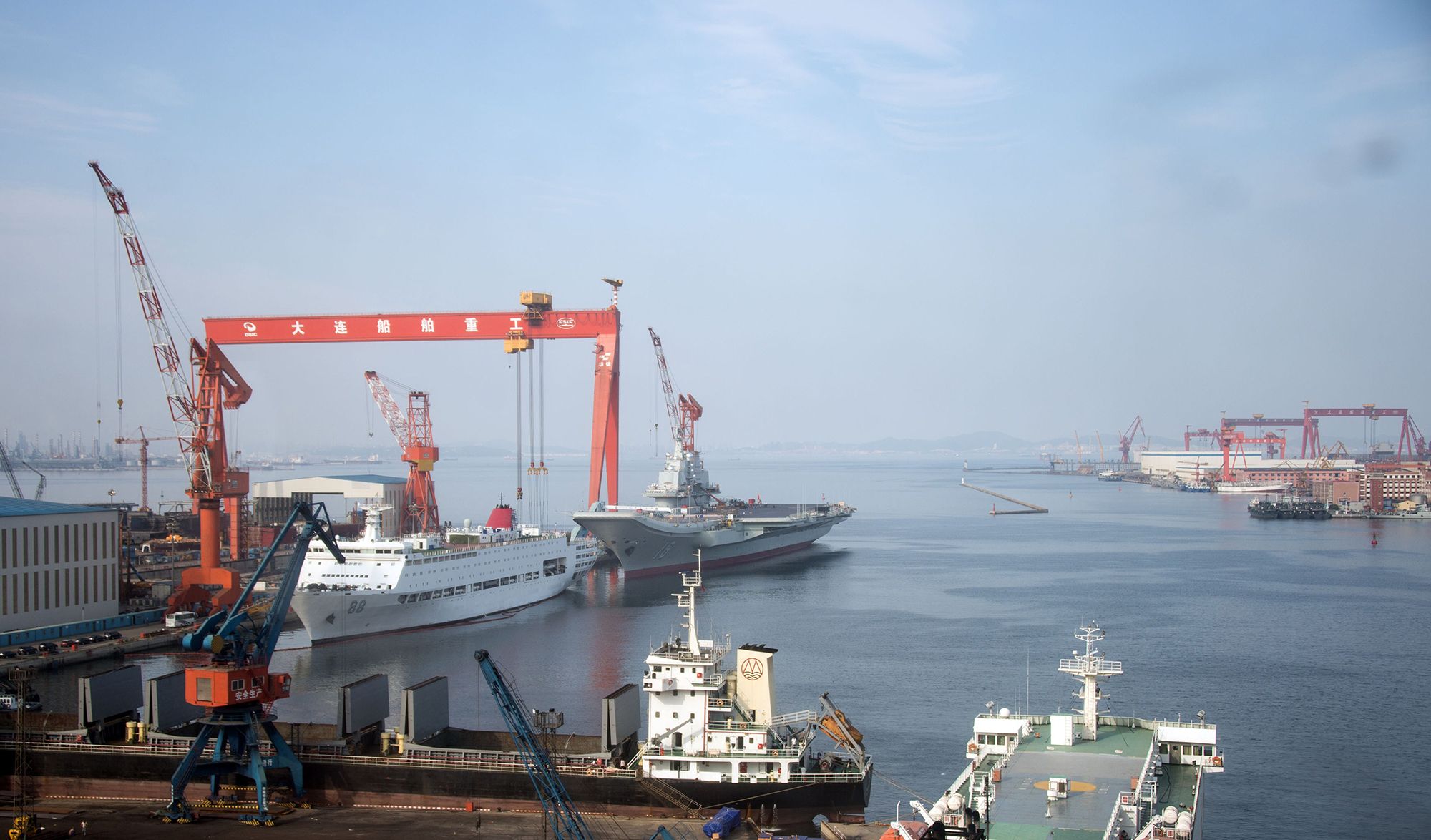
China’s naval expansion allows it to play a greater role in international security issues. As of 2018, the Chinese Navy consists of over 300 ships, making it larger than the US Navy’s 287 deployable vessels. Learn more.
Despite considerable increases over the past fifteen years, China’s military budget pales in comparison to that of the US. The US spent 3.4 percent of its GDP on defense in 2019, and its nominal expenditure was more than two and a half times higher than that of China. Even when accounting for reporting discrepancies, China would have to raise its spending considerably to match the US defense budget. However, it is worth noting that the United States maintains a global military presence while China remains primarily focused on security issues within the Indo-Pacific.
When considering military spending as a percent of total government expenditure, Chinese military spending has dropped noticeably — from 12.0 percent in 2001 to 5.4 percent in 2019. After a marked increase from 2002 to 2011, US spending has likewise decreased and returned to pre-September 11 levels (9.6 percent in 2001 and 9.4 percent in 2019). Although Russia’s spending remains high, it declined from 14.8 percent in 2016 to 11.4 percent in 2019. For the most part, spending elsewhere in the region either dipped in 2019 or remained steady.
Looking at broader regional trends, East Asia spends close to the same amount as Western and Eastern Europe combined. East Asian spending has increased from $92.8 billion in 1990 to $363 billion in 2019. Much of this growth in expenditure has been driven by China. In 1990, China constituted 23.6 percent of total East Asian expenditure. As of 2019, this number stands at 70.5 percent. In terms of the broader regional context, the Chinese military budget constitutes 52.2 percent of the total cumulative spending across all of Asia (including those in the Middle East)
What Do Chinese and Russians Think of the U.S. Military?
A recent article touches on U.S. perceptions of its military. But how do other countries view it?
In the article “The Tragedy of the American Military,” author James Fallows posits that the U.S. military escapes external scrutiny due to a growing gap between those who have and those who have not served. The result of this gulf is that “outsiders treat it both too reverently and too cavalierly, as if regarding its members as heroes makes up for committing them to unending, unwinnable missions…” Fallows postulates that this results in the creation of a “Chickenhawk Nation, based on the derisive term for those eager to go to war, as long as someone else is going. It would be the story of a country willing to do anything for its military except take it seriously.”
Fallows appears to have re-ignited a new discussion on civil-military relations in the United States as illustrated by the many thoughtful responses by readers of the article. However, after reading the article and going over some of the comments, what appears to be missing so far in the discussion is the view of the genuine outsiders: How do people in countries such as China and Russia view the U.S. military?
The default answer to that question is simple: They view it as a threat.
According to a Spring 2014 Attitudes Survey by the PEW Research Center, China sees the United States as its biggest threat. Another survey conducted in Russia showed that Russians are more afraid of the United States than the Islamic State. This should not come as a surprise. The one thing any foreigner cannot do is to refuse to take the U.S. military “seriously” – after all it is the most deadly force in the world and, given the history of U.S. civil-military relations, more likely to be used outside the United States than inside the country. So if, as Fallows postulates, there is a growing gap between the civilian and military worlds in the United States, and – most importantly – if the cost of war is only shared by a tiny percentage of the population, foreigners may be excused for assuming that this will perhaps lead to increased U.S. bellicosity.
While there is of course a difference in perceptions between U.S. allies and U.S. adversaries, I posit that the sensation of this latent fear holds true, in varying degrees, for a diverse range of countries (in 2013 another survey found that the United States was seen as the greatest threat to peace in the world). The United States is the indispensable military power, but this seldom translates into genuine gratitude and more often than not slides into open anti-Americanism, as history has illustrated time and again. Based on my own discussions with policymakers in Europe and Asia, the attitude of most U.S. allies is that the only thing worse than fighting with the United States is to fight without her.
No matter how much American pundits and scholars of U.S. civil-military relations point to the marginalization of the military within the United States, to outsiders, the perception is often that of a “New Prussia” – partially brought about by the everyday veneration of U.S. service personal, but more importantly by the sheer preponderance of U.S. military power. As I have pointed out elsewhere, a report by the Advisory Committee on Transformational Diplomacy illustrates how superior resources may cause a skewed perception:
DoD’s regional combatant commanders have come to be perceived by states and other actors as the most influential U.S. government regional representative. It is argued that the resources that combatant commanders control, their presence and frequent travel throughout the region, and even the symbolic impact of their aircraft and accompanying service members, all combine to place them in perceived position of preeminence.
This assertion is supported by a study of The Project on National Security Reform (PNSR), the most comprehensive effort to date to analyze the U.S. national security system and propose recommendations to alleviate many of its bureaucratic problems (disclaimer: I worked as a research analyst for PNSR). Its report conclusion emphasizes that an inequality of resources leads to an inequality in policy; i.e., the militarization of U.S. foreign policy.A
True or not, this perception is also widespread outside the United States. Consequently, the alleged militarization of U.S. Foreign Policy paired with Fallows’ assertion of the United States as a “chickenhawk nation” should cause some consternation among security analysts – not only in Beijing and Moscow, but perhaps also in Western European capitals.
China Threatens to Throw America 'Into the Mighty Sea of the Coronavirus.'
China is threatening to wreak havoc on America’s drug supply amid the Wuhan coronavirus outbreak. Thanks to our globalist elite and especially missteps during the Obama-Biden administration, Beijing has the power to do just that.
China is threatening to wreak havoc on America’s drug supply amid the Wuhan coronavirus outbreak. Thanks to our globalist elite and especially missteps during the Obama-Biden administration, Beijing has the power to do just that.
In an article in Xinhua, one of the Chinese Communist Party’s mouthpieces, Beijing threatened that it can impose pharmaceutical export controls after which America will be “plunged into the mighty sea of coronavirus.”
Unfortunately, Beijing isn’t bluffing about this capability.
As Rosemary Gibson, co-author of “China Rx: Exposing the Risks of America’s Dependence on China for Medicine,” testified to a congressional commission last summer, China has a dominant role in the manufacture of the generic drugs that comprise 90 percent of what Americans take.
Even finished drugs from other sources are dependent on China. Another major source of generic drugs is India, and 80 percent of that country’s drug ingredients come from China.
There are many culprits behind this betrayal, but some deserve special mention.
Foremost is the globalist cabal that exported our industries to China in the name of “free trade.” As Gibson also reports, within four years of passage of the Clinton-era law giving China unfettered access to U.S. markets and WTO membership, “the last penicillin fermentation plant in the U.S. closed; China’s vitamin C cartel forced the closure of the last U.S. production facility, and the last aspirin manufacturing facility ceased business because of predatory pricing by Chinese firms.”
The Chinese government has used its favorite playbook to make the world dependent on its drugs: protecting and subsidizing domestic manufacturers to undersell American competitors, aided by Chinese industrial espionage. Indeed, biotechnology is one of ten categories of Beijing’s “Made in China 2025” industrial strategy which has driven so much of its theft of intellectual property and dumping of goods at below-market prices to kill U.S. businesses.
Among the globalists, the former Obama-Biden administration is particularly culpable for putting America at risk. During the eight years of that administration, then-Vice President Biden was often the frontman for responding to the increasing number of foreign outbreaks to which America has been exposed.
During the H1N1 (swine flu) pandemic in 2009, Biden incorrectly addressed the public about the outbreak, “I would tell members of my family, and I have, I wouldn’t go anywhere in confined places right now… It’s that you are in a confined aircraft. When one person sneezes, it goes everywhere through the aircraft.”
Speaking about the 2014-2016 Ebola outbreak, Biden recently said, “I was part of making sure that pandemic did not get to the United States, saved millions of lives.” In fact, the Obama administration admitted people known to have the disease to America.
During the Zika virus outbreak, Biden was in charge of pressuring Congress for funds.
Are we to believe that amid all of this attention to outbreak that Biden and his globalist colleagues didn’t know of America’s growing inability to make even the most basic pharmaceuticals? Throughout the Obama-Biden administration, our dependence on China got much worse.
Last month, Biden criticized the Trump administration’s response to Wuhan coronavirus. Initially, he slammed the president’s unprecedented decision to stop flights from China: “This is no time for Donald Trump’s record of hysteria and xenophobia--hysterical xenophobia--and fearmongering.”
Later he flip-flopped to accusing Trump of not doing enough, imagining if he were president that, “I would be on the phone with China making it clear we are going to need to be in your country. You have to be open. You have to be clear. We have to know what’s going on.”
Of course, Beijing’s unwillingness to allow anything of the sort is a reason their coronavirus has spread far and wide. Oddly, Biden and his fellow globalists remain sanguine about China and their ability to influence its communist government. Last year, he said of China, “they’re not bad folks,” and “they’re not competition for us.”
Of course Biden was not alone, and neither were the Democrats. The House of Bush was always fond of the myth that economic engagement of China, evidently on terms favorable to Beijing, would turn an adversary into an ally. The myth lives on. Bob Zoellick, who was George W. Bush’s trade kingpin, has been an outspoken opponent of Trump’s effort to end U.S. dependence on China, lamely claiming, “You can’t contain China.”
To fix this medical vulnerability, Trump should apply gradually increasing, permanent tariffs on Chinese drugs and ingredients. He should also establish a strategic reserve of drugs by requiring the Defense Department and Veterans Affairs to buy only drugs that are 100 percent made in America. This domestic demand would create domestic supply.
Trump should also press drug companies to start a crash program to achieve supply chain independence from China. If would be great if he could achieve this through an appeal to patriotism. If not, he should use the Defense Production Act of 1950 to force the issue.
It’s time to reverse the globalist sellout of America that has put Beijing in charge of our drug supply chain.
"China Is A Threat To The World, Building Military Rapidly": Donald Trump
China has hiked its military spending by seven per cent to USD 152 billion as Beijing aims at countering America's push into the disputed South China Sea.
"China is a threat to the world...they are building a military faster than anybody," Trump said
Expressing concern over China's growing military might, US President Donald Trump has said the Communist nation is a threat to the world and blamed his predecessors for not stopping it from stealing America's intellectual property to bolster its defence capabilities.
China has hiked its military spending by seven per cent to USD 152 billion as Beijing aims at countering America's push into the disputed South China Sea.
"Obviously China is a threat to the world in a sense because they are building a military faster than anybody and frankly they are using US money," Donald Trump, who was accompanied by visiting Australian Prime Minister Scott Morrison, told reporters in Washington on Friday.
Donald Trump said the US Presidents before him allowed China to take out USD 500 billion a year and more than that. "They have allowed China to steal our intellectual property and property rights and I'm not doing that," he said.
However, President Trump said the two countries were very close to having a trade deal.
"We work very closely, had intellectual property, all of the tough things work negotiated and then at the last moment, they said we cannot agree to this," he alleged, referring to the abrupt collapse of the trade deal with China early this year.
"I said that's all right we are charging you 25 per cent tariffs and then it's going up and it will continue to go up. Frankly we are making so many hundreds of the numbers that we are taking in to our treasury...Look at the great reports that came out two days ago on retailing, on consumers, on numbers that nobody believes," he added.
The world's two largest economies are locked in a trade war since Donald Trump in March last year imposed tariff hikes of up to 25 per cent on USD 250 billion of Chinese goods. In response, China, the world's second largest economy after the US, imposed tit-for-tat tariffs on USD 110 billion of American goods.
The two countries have resumed their trade negotiations.
Donald Trump has said that he will enter into a trade deal with Beijing only if he is confident that it is good for the US.
"We are taking hundreds of millions potentially over a short period of time, hundreds of billions of dollars worth of money is coming in from China that never came in before so China wants to make a deal, I think we want to make a deal," Donald Trump said.
"We will see what happens, but I view China in many different ways, but right now I am thinking about trade. But you know trade equals military because if we allow China to take USD 500 billion out of the hide of the United States that money goes into military and other things," said the US president.
Donald Trump went on to say that "They're having a bad year. Worst year in 57 years. Their tariffs aren't coming into us. We're taking in billions and billions of dollars of tariffs. They are devaluing their currency, which means the tariffs are not costing us probably anything, but certainly not very much. They're also adding a lot of money into their economy. They're pouring money into their economy, but were taking in many billions of dollars," he said.
"At some point in the not-too-distant future, it'll be over USD 100 billion. We've never taken in 100 cents from China. It was always the other way around. With that, they lost over 3 million jobs there. Supply chain is crashing, and they have a lot of problems. And want to make a deal. So, we'll see what happens," Donald Trump said.


 ANDAIR VA-150